What Is Radiant Barrier?
Radiant barrier is a low-emittance, highly reflective building material used primarily to reduce radiant heat transfer across an air space. It works alongside conventional insulation rather than replacing it.
A different job than bulk insulation
Fiberglass, cellulose, and foam primarily resist conductive heat flow. Radiant barrier addresses the radiation component of heat transfer between a hot roof deck and cooler attic surfaces, including ductwork and attic-floor insulation.
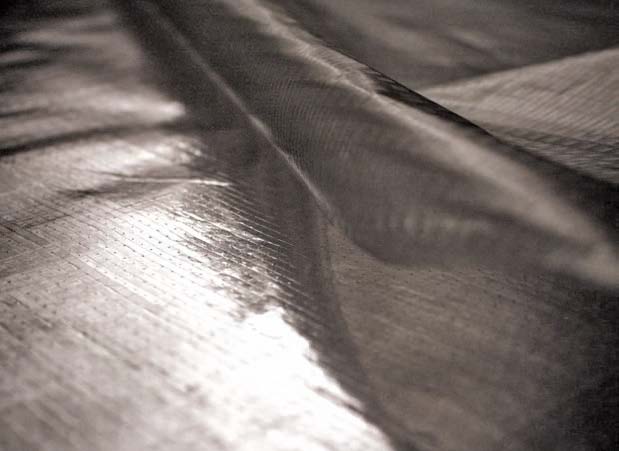
Ra-flect is reflective on both sides. There is no required front or back orientation, but at least one reflective face must border an adjacent air space.
Three ways heat moves
Conduction
Heat moves through solid materials. Conventional insulation is rated by how strongly it resists this heat flow.
Convection
Heat moves with circulating air or fluid. Air sealing and controlling airflow are important parts of the building assembly.
Radiation
Heat travels as electromagnetic energy between surfaces. A low-emittance reflective surface reduces this exchange across an air space.
Where Ra-flect fits
- Existing vented attics, commonly stapled beneath roof rafters.
- New roof, wall, cathedral-ceiling, floor, and crawl-space assemblies designed with an air space.
- Projects with attic ductwork or equipment that benefit from reduced radiant exposure.
- Residential, commercial, and architectural work requiring documented material properties.
Ready to choose the material?
Laser Perforated (LP) is the safer default for most vented attic and breathable assemblies. Vapor Barrier (VB) is for assemblies intentionally designed to use a non-perforated vapor or radon barrier.
Technical background: U.S. Department of Energy, Radiant Barriers and Federal Trade Commission, Buying Home Insulation.